
Pool Losing Water? Leak vs Evaporation — the Bucket Test
Every Florida pool loses water. Sun, heat, and wind pull moisture off the surface every day, and in a Clermont summer that loss is big enough to fool anyone. The question is never …
Every Florida pool loses water. Sun, heat, and wind pull moisture off the surface every day, and in a Clermont summer that loss is big enough to fool anyone. The question is never 'is my pool losing water?' — it is 'is it losing more than evaporation explains?' This guide gives you the numbers for normal loss, the bucket test that separates evaporation from a leak in 24 hours, how to read the result — including the pump-on, pump-off second test that tells you whether the leak is in the plumbing or the shell — and the point where self-testing stops and detection starts.
How much evaporation is normal in Florida?
In Central Florida, expect roughly 1/8 to 1/4 inch of evaporation per day in typical conditions — call it 1 to 1.5 inches a week. Hot, windy, low-humidity stretches push it higher; a screen enclosure, shade, and a solar cover pull it lower. Splash-out from swimmers and backwashing the filter add honest losses on top, which is why 'I add water about once a week in summer' is, by itself, normal.
What is not normal: needing to add water two or three times a week, a level that drops noticeably overnight when evaporation is at its daily lowest, an auto-fill that runs far more than it used to, or any loss above about 2 inches a week without heavy use or extreme weather. Those patterns earn the bucket test — free, one day, no equipment beyond a bucket and a marker.
The bucket test, step by step
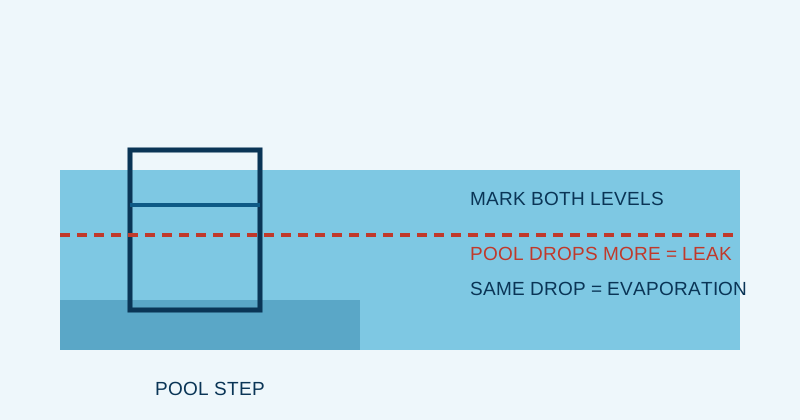
The logic is beautifully simple: a bucket of pool water, sitting in the pool, evaporates at exactly the same rate as the pool itself. If the pool drops more than the bucket over the same period, the extra loss left through a hole, crack, or pipe — a leak. Use the checklist below for the mechanics, and note the two details that make or break the result: the bucket sits on a step so its water shares the pool's temperature and conditions, and the test runs a full 24 hours with the pump on its normal schedule.
Rain ruins a test day — it tops up pool and bucket alike but rarely equally — so pick a dry day, keep swimmers out if you can, and switch the auto-fill off for the duration, or it will quietly replace the leaked water and hide the very loss you are measuring.
Reading the result — and the second test that locates the type
Compare the two marks. If pool and bucket dropped by the same amount, your loss is evaporation (and splash and backwash), and you can stop worrying until the pattern changes. If the pool dropped more — even 1/4 inch more over the day — you have a leak, and the difference, scaled up, is roughly its daily rate.
Now run the same test for a second 24 hours with the pump off the whole time (keep the water sanitised and run the pump again promptly afterwards). If the loss shrinks or stops with the pump off, the leak is on the pressure side of the plumbing — it only leaks while the system is pressurised. If the loss is the same pump on or off, suspect the shell, a fitting, the skimmer, a light niche, or the suction side. That one distinction is the first thing a pool leak detection visit tests, and arriving with the answer saves real time.
Before you conclude: the other honest losses
Rule out the mundane first. A filter backwash or cartridge rinse sheds hundreds of gallons legitimately. A multiport valve with a worn spider gasket can pass water to the waste line while the pump runs — check whether the waste or backwash line drips or flows when it should not. Sprinkler overspray hitting the pool can even add water and confuse a week's pattern. And check the obvious wet clues: a soggy patch by the equipment pad, a fitting that weeps only under pressure, air bubbles in the pump basket.
If the bucket test says leak and the mundane causes are cleared, further DIY narrows slowly. Dye around every fitting is possible but tedious and easy to misread in moving water, and pool plumbing pressure testing needs proper plugs and gauges. That is the natural hand-off point — and knowing it is plumbing-side or shell-side from your two tests means the specialist starts halfway to the answer. A pool that is leaking also raises the stakes quietly: lost water is treated, heated, chlorinated water, and a shell or line leak left running can erode the soil supporting the deck.
A worked example: what a quarter-inch really means
Inches are abstract; gallons are not. Take a typical 15 × 30 ft Clermont pool: one inch of depth across that surface is about 280 gallons, so the normal-looking quarter-inch of daily evaporation is roughly 70 gallons, and a week of it is near 500 gallons. That is why evaporation alone explains a weekly top-up — and why it cannot explain two inches a week, which on the same pool is over 1,100 gallons of treated, heated water leaving somewhere it should not.
Use the same maths on your bucket-test result. If the pool dropped a quarter-inch more than the bucket in 24 hours, your leak is losing roughly 70 gallons a day on a pool that size — about 2,100 gallons a month, running through the shell, a fitting, or a line until it is found. Numbers like that turn 'watch it another week' into a decision you can actually weigh.
Bucket test checklist
- Fill a bucket with pool water and set it on a step, water levels matched inside and out
- Mark the water level inside the bucket and the pool level on the bucket's outside
- Turn the auto-fill OFF; leave the pump on its normal schedule
- Wait a full 24 hours — no swimmers, no rain
- Compare: pool dropped more than the bucket = leak
- Repeat 24 hours with the pump off: less loss = plumbing-side leak; same loss = shell or fitting
Pool water loss in Clermont
Clermont's pools — the lanai pools of Kings Ridge and Summit Greens, the family pools in Legends and Sawgrass Bay — run year-round, so 'evaporation season' never really ends and neither does leak season. Summer's heat and afternoon storms make weekly loss hard to judge by eye, which is exactly what the bucket test is for. If yours confirms a leak, one call connects you with a Clermont pool leak specialist who pressure-tests the lines and dye-tests the shell and fittings — and if a skimmer replacement turns out to be the fix, you will already know what that job involves and what it typically costs.
Sources and further reading
Pools by Bradley — normal evaporation for a Central Florida pool and the bucket test
Pool Leak vs Evaporation — FAQs
How many inches a week means a leak, not evaporation?
Why did my bucket test show nothing, but I still think it leaks?
Does evaporation slow down in a Florida winter?
My pool loses water only when the pump runs. What does that mean?
Think you have a leak in Clermont?
The longer a hidden leak runs, the more damage it does. Call now and get connected with a Clermont leak detection specialist.
Call +1 (352) 716-1109★ 4.9 from 150+ local reviews · Licensed specialists · Open 24/7 · Delivers the best
Related Leak Detection Services
Pool Leak Detection
In Clermont, a pool is part of the house — and a leaking pool loses far more than water. Pool leak detection t…
Irrigation Leak Detection
Irrigation leaks are Clermont's silent water bill killers — a broken head, a cracked lateral line, or a stuck …
Underground Leak Detection
The main water line running from your meter to your house crosses your yard underground — and when it leaks, t…
More Leak Detection Guides
7 Signs of a Slab Leak in Your Florida Home
A slab leak is a pressurised water line leaking under your home's concrete foundation. It rarely announces its…
Why Is My Water Bill So High All of a Sudden?
A water bill that jumps suddenly is not a billing mystery to shrug at — it is data. If you are asking "why is …